AltLife Sim
- 4.2
- Rating
- 50.00K
- Installs
- Free
- Price

 Analysis by App-foxy
I went into AltLife Sim expecting a familiar life simulator, but its main appeal became clear quickly: it gives me room to steer a character through decisions without forcing every session into the same narrow path. That makes it a good fit for short, curiosity-driven play, especially when I want to see how one choice changes the next stage of a virtual life. It is not a detailed management game or a dramatic story adventure, though, and that distinction matters before you download it.
Developed by Bountiful Games, LLC, this free simulation game is built around choosing a direction and, importantly, creating your own destiny through the options presented during play. The idea sounds simple, yet it works best when I treat each run as an experiment rather than as a campaign I must complete perfectly. My overall view is positive: the game is easy to approach, encourages replaying decisions, and suits players who enjoy imagining alternate versions of their lives. Its limitations are just as clear: anyone looking for deep control, a strong visual world, or a tightly scripted narrative may find it too lightweight.
How the life-simulation loop feels in practice
The first thing I appreciate is the low barrier to entry. A life simulator can become intimidating when it presents too many systems at once, but AltLife Sim puts the central question in front of me: what should happen next? That direct structure makes it possible to play casually, without needing a long uninterrupted session or a large amount of preparation.
You May Also Like

 AccuWeather: Weather Radar
AccuWeather Review: A Quick, Clear Forecast for Everyday Decisions
For everyday plans, the best forecast is the one you can understand quickly. AccuWeather makes rain timing, radar, and local conditions easy to act on, with a few trade-offs.

 Hill Climb Racing
Why Hill Climb Racing Still Turns Crashes Into One More Run
A tiny car, a bumpy hill and one more upgrade: Hill Climb Racing keeps resurfacing because its simple chaos makes every near-miss feel personal.

 AliExpress - Shopping App
AliExpress Makes Global Shopping Feel Personal, but Shoppers Bear the Risk
AliExpress turns a global marketplace into a pocket-sized discovery engine. Its reach is useful, its shopping loop compelling, and its trade-offs easy to miss.

 Lords Mobile: Kingdom Wars
Lords Mobile Is a Kingdom-Building Routine, Not a Quick Match
A case-by-case verdict on the building, battles, device demands, and social commitments that make Lords Mobile rewarding for some players and exhausting for others.

 PDF Scanner app - TapScanner
TapScanner Makes Paperwork Easier to Capture, Check, and Share
TapScanner makes scanning with a phone feel less like a rescue operation and more like a dependable step in getting work done. Its capture tools are useful, though not flawless.

 Block Blast!
 Shows How Much a Puzzle Game Can Leave Out
A quiet grid game shows why puzzle players increasingly value instant clarity, repeatable skill and low-pressure play—and where the genre still needs to catch up.
More From Our News Desk
View All News


I found the choice-based format most enjoyable when I stopped trying to make every decision sensible. A cautious run can be interesting, but so can a deliberately unpredictable one. Picking the option that seems risky, then watching the consequences unfold, gives the game its strongest reason to be replayed. The experience is less about mastering a fixed set of mechanics and more about testing different approaches to the same broad idea of living a virtual life.
That also gives the game a useful rhythm for mobile play. I can open it while waiting for an appointment, make a few decisions, and put it down without feeling that I have abandoned a complex construction project. Later, I can return with a different plan. For me, that makes it more convenient than simulation games that demand constant attention or lengthy sessions to make meaningful progress.
The wording of the choices is important in a game like this. I read each one as a prompt for role-playing, not merely as a button that increases or decreases an invisible score. If I decide what kind of person I want the character to be before starting, the run feels more coherent. Without that small bit of self-imposed direction, the experience can become a sequence of disconnected taps.
A practical way to get more from it is to keep a simple mental rule for each run. I might play as someone who values stability, someone who takes every opportunity, or someone who reacts emotionally. This does not add a new feature to the game; it changes how I interpret the available decisions. The result is a more personal experience and a clearer way to compare one playthrough with another.
Why replaying decisions is the real attraction
The strongest evidence that the concept works is how naturally it invites comparison. After making an important choice, I often want to restart and select the alternative, not because the first run failed, but because I want to understand the shape of the other possibility. That curiosity is the heart of the game.
This approach is especially useful for players who enjoy “what if” questions. What if I had taken the safer option? What if I had accepted an opportunity instead of waiting? What if I made decisions based on a personality completely unlike my own? The game turns those questions into small, repeatable experiments.
There is also a social use for that format. I can hand the phone to a friend and ask what they would choose, then compare our imagined lives. It is a simple way to make the game more interactive without requiring multiplayer features or a competitive ranking system. The fun comes from discussing the reasoning behind a choice and seeing whether the outcome matches expectations.
One non-obvious strength is that the game can work as a break from decision-heavy entertainment. In many simulation titles, I have to optimize resources, arrange buildings, monitor timers, or remember several objectives. Here, I can focus on the meaning of the next decision. That makes it less mentally demanding, although it also means that players who enjoy detailed optimization may find less to manage.
I would recommend beginning with a blind run rather than searching for the “best” path immediately. Looking for an ideal outcome can reduce the surprise that makes this type of simulator enjoyable. Once I understand the general flow, repeating the experience with a specific goal becomes more rewarding. For example, I can try to make consistently cautious choices, then compare that run with one built around spontaneity.
The trade-off between freedom and depth
The game’s promise of shaping a personal destiny is appealing, but I would describe that freedom as guided freedom rather than unlimited control. I choose among the situations and directions the game presents. I am not building every part of a world from scratch, and I should not expect the level of systemic detail found in a full management simulation.
That trade-off keeps the experience approachable. The developer, Bountiful Games, LLC, appears to be aiming for a compact decision-led format rather than a sprawling life-management package. For a phone game, that focus is sensible. It lets me get to the interesting part quickly, but it also places a lot of pressure on the quality and variety of the choices. When the available options feel meaningful, the game is engaging; when they feel too similar, the illusion of control becomes weaker.
My biggest limitation with this style of play is the possibility of repetition. Once I understand the broad pattern of a run, some decisions can lose their surprise. The answer is not necessarily to play longer. In my experience, shorter sessions and occasional returns work better than trying to turn the game into an all-day activity. A break gives the next run more room to feel fresh.
This is also where expectations should be managed. If you want a life simulator with extensive customization, detailed schedules, highly visual environments, or a large strategic economy, this is probably not the right choice. A more elaborate simulation would serve you better. AltLife Sim is more suitable when the decision itself is the entertainment.
Another trade-off concerns the free-to-play model. The game is free to download, while optional in-app purchases range from $1.99 to $99.99 per item. That wide range means I would approach purchases carefully and decide in advance whether the basic experience already satisfies me. Players who dislike any purchase prompts or prefer a single upfront price may feel more comfortable with a paid alternative instead.
The Teen content rating is another useful signal for families. I would not treat the game as a children’s title simply because the controls are easy. Parents should consider whether a choice-driven life simulator matches the maturity level they want for a younger player. For older teens and adults, the rating is a reminder to pay attention to the themes and decisions rather than assuming the game is purely playful.
Everyday scenarios where it fits best
Imagine that I have ten minutes before a train arrives. I do not want to start a large strategy game, remember a complicated objective, or risk losing progress because I have to leave suddenly. AltLife Sim fits that moment well: I can make a few choices, see how the virtual situation develops, and close the game when my time is up.
It also works after a long day when I want something interactive but not demanding. I can create a run around a simple idea, such as always choosing the option that offers security, and let the consequences provide the entertainment. That is more engaging than passively scrolling, while still being relaxed enough for a short evening session.
A third use is as a conversation starter. Playing with a friend, I can ask which decision they would make before revealing my own choice. The game becomes less about reaching a perfect ending and more about comparing values, instincts, and expectations. That is a genuine strength because it gives the experience a social layer without requiring the app itself to be a social network.
For players who enjoy writing or creating characters, the game can act as a quick prompt generator. I can invent a personality, make decisions on that character’s behalf, and use the unexpected direction of the run to develop a story idea. It is not a replacement for a dedicated writing tool, but it can provide a useful spark when I want an unpredictable starting point.
My most useful tip is to avoid judging a run only by its outcome. The interesting part is often the chain of reasoning that leads there. If an ending feels disappointing, I can ask which earlier decision created that direction and replay from the beginning with one change. That approach makes the game feel more like an interactive thought experiment than a pass-or-fail challenge.
Who should try it, and who should skip it?
I think AltLife Sim is best for players who enjoy branching choices, alternate scenarios, and lightweight simulation. It is particularly appealing if you like imagining consequences but do not want to manage inventories, construction layouts, or complicated statistics. It also suits people who prefer games that can be played in small bursts and revisited whenever curiosity returns.
Fans of traditional life simulators should approach it with a specific expectation. If your favorite part of the genre is decorating a home, controlling detailed routines, customizing appearances, or watching characters move through a richly animated world, this game may feel too abstract. Its focus is the decision path, not the visual ownership of a virtual life.
Players who want a fixed story may also prefer a narrative adventure. Here, the appeal comes from changing the path and seeing what follows, so the experience is less about discovering one carefully authored plot. On the other hand, if you enjoy making choices without knowing exactly where they lead, the format is likely to suit you better than a linear game.
The current version is 0.21.2, and the game supports Android 7.0 or later. That makes it accessible to people using older compatible Android devices, although the practical experience will still depend on the phone itself and how comfortable its screen and performance feel during play. The game has passed fifty thousand installs, with an average rating of 4.2 from more than four hundred ratings and over seventy reviews, suggesting that it has found a receptive audience while remaining a relatively focused title rather than an enormous mainstream platform.
I would also think about your tolerance for monetization before installing. Because the download is free but purchases are available, the best approach is to enjoy the core loop first and avoid spending simply to chase a better run. If you prefer knowing the complete cost from the start, look for a paid simulation instead. If you are comfortable trying a free game and making your own spending boundary, the model is easier to live with.
My verdict after living with the concept
AltLife Sim succeeds because it understands that a life simulator does not always need a huge world to create interesting questions. Its choice-led format gives me an easy way to test different personalities, compare alternate decisions, and turn a few spare minutes into a small interactive story. The best sessions are not the ones where I search for a perfect life; they are the ones where I commit to a role and accept the consequences.
At the same time, the game’s simplicity is both its strength and its boundary. I would not choose it for deep resource management, extensive customization, or a visually rich simulation. Repetition can become noticeable if I play too many runs in succession, and the optional purchase structure deserves some caution, particularly for anyone who prefers a one-time payment.
For me, the recommendation is clear but specific: try it if you want a compact choice-based life simulation that rewards curiosity and replaying decisions. Skip it if you need a detailed virtual world or a long-form story with tightly controlled pacing. As a free game from Bountiful Games, LLC, it offers a simple premise with enough flexibility to make short sessions meaningful, provided you treat each run as an experiment rather than expecting it to replace a full-scale life simulator.
My final take: this is a thoughtful pick for casual simulation fans who enjoy asking “what would happen if I chose differently?” It is most enjoyable when played in focused bursts, with a personal role or rule guiding each run. That modest approach will not satisfy everyone, but for the right player, it turns ordinary decisions into a surprisingly repeatable source of entertainment.
FAQs for AltLife Sim
01What is AltLife Sim?
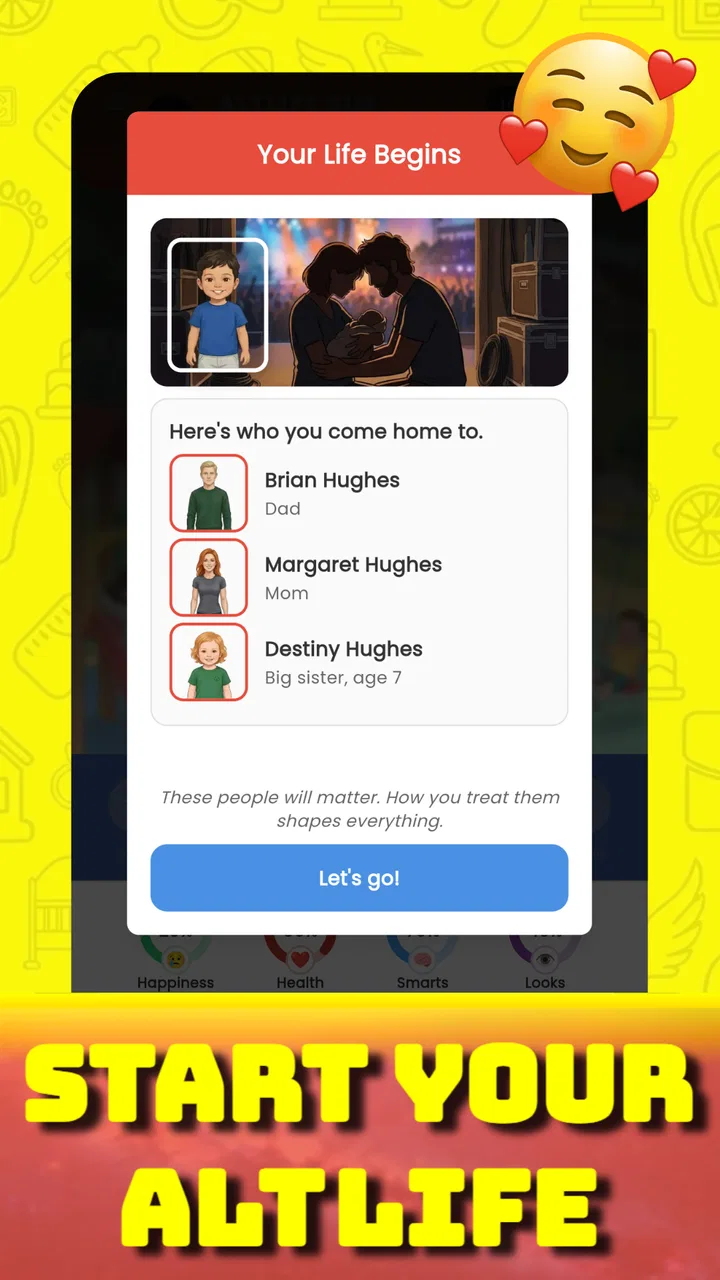
AltLife Sim is a life simulation game in which you guide a virtual character through different stages of life. You make choices about education, careers, relationships, finances, health, and personal goals, then see how those decisions affect the character’s future. Its text-based presentation focuses more on decision-making and replayability than on detailed graphics or real-time action.
02How does the gameplay work in AltLife Sim?
Gameplay is based mainly on making choices as your character grows older. You can decide how to spend time, manage money, pursue work or education, develop relationships, and respond to unexpected events. Each decision may create new opportunities or problems, so the experience is not completely predictable. Players who enjoy experimenting with different lifestyles will find plenty of reasons to replay it.
03Is AltLife Sim free to download and play?
AltLife Sim can generally be downloaded without an upfront purchase, but the exact availability of advertisements, optional purchases, or premium features may depend on the platform and current version. Before installing, it is worth checking the store listing for updated pricing information. Players should also review any in-app purchase settings, especially if the game will be used by children or on a shared device.
04Does AltLife Sim require an internet connection?
Many parts of AltLife Sim are designed around local, menu-based gameplay and may work without a constant internet connection. However, certain functions—such as advertisements, analytics, updates, cloud-related features, or store purchases—could require access to the internet. If you plan to play while traveling, test the game offline after installation, because requirements can change between app versions and devices.
05Is AltLife Sim suitable for children?
AltLife Sim is primarily intended for players who are comfortable with mature life themes and making decisions about subjects such as relationships, money, careers, health, and personal consequences. The appropriate age rating may vary between Android and iOS. Parents should check the current store rating, privacy information, advertising details, and in-app purchase options before allowing younger players to download and use the game.
Pros
- Detailed life-simulation choices create varied playthroughs.
- Simple menus make the game easy to learn and navigate.
- Random events add surprise and replay value.
- Career
- relationships
- and finances offer multiple goals.
- Playable offline
- making it convenient for travel or limited data.
Cons
- Frequent decisions can become repetitive during longer sessions.
- Some features may be restricted behind in-app purchases.
- Text-heavy gameplay may not appeal to fans of visual simulations.
- Progress can feel slow without watching ads or spending resources.
- Limited social interaction reduces its appeal for multiplayer fans.

AltLife Sim
Gallery